Blog / Salary & Compensation
New Labour Codes: Why Your Take-Home May Drop
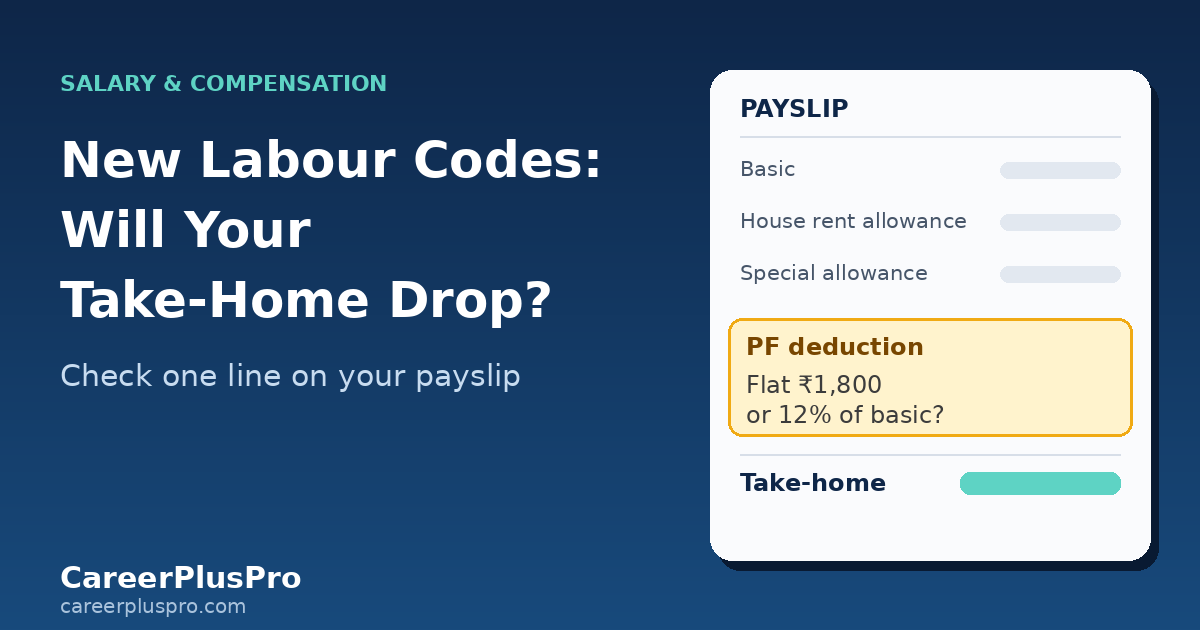
Short answer: the new labour codes will not cut take-home pay for every employee. Your in-hand salary drops only if your employer calculates provident fund (PF) on your full basic pay, and your basic rises under the new 50% wage rule. If your PF is a flat ₹1,800 a month, the Labour Ministry says your take-home is unaffected. Check your payslip first, then read on.
What changed, and when
The four labour codes came into force on 21 November 2025. The Central Government notified the final central rules on 8 May 2026. State rules may differ, so your state's version can matter for some provisions.
For salaried employees, the change that matters most is the new definition of "wages", because that figure now drives PF, gratuity, leave encashment, overtime and statutory bonus calculations.
The 50% wage rule in plain words
Under the Code on Wages, "wages" means basic pay plus dearness allowance (and retaining allowance, if any). Several items are kept out of wages, such as house rent allowance, conveyance allowance, employer PF contribution, overtime and statutory bonus.
The rule: if those excluded items add up to more than 50% of your total remuneration, the excess is added back to wages. In practice, your basic pay and DA must be at least half of your total pay. Many salary structures kept basic at 30–40% and pushed the rest into allowances. That structure no longer works as it did.
Will your take-home drop? Check this one line
Open your latest payslip and find the PF (Provident Fund) deduction.
- PF is a flat ₹1,800 a month: your PF is calculated on the statutory wage ceiling of ₹15,000 (12% of ₹15,000). The Labour Ministry has clarified that take-home does not reduce in this case, even if your basic pay rises. PF on wages above ₹15,000 is voluntary.
- PF is 12% of your full basic pay: your employer contributes on actual basic. If your basic rises to meet the 50% rule, your PF deduction rises with it, and your monthly in-hand pay falls.
- Your basic plus DA is ₹15,000 or less: PF is compulsory on your actual wages, so a higher basic does raise your deduction.
Not sure which one applies to you? Our CTC to in-hand salary calculator lets you choose between PF on 12% of actual basic and PF capped at the ₹15,000 wage ceiling, so you can see both results for your own CTC.
Worked example: PF on full basic
Assumptions: gross monthly salary stays the same, basic moves from 40% to 50% of gross, employee PF is 12% of basic. Figures are before income tax and professional tax.
| Monthly gross | Basic before → after | PF before → after | Fall in monthly take-home |
|---|---|---|---|
| ₹40,000 | ₹16,000 → ₹20,000 | ₹1,920 → ₹2,400 | ₹480 |
| ₹60,000 | ₹24,000 → ₹30,000 | ₹2,880 → ₹3,600 | ₹720 |
| ₹1,00,000 | ₹40,000 → ₹50,000 | ₹4,800 → ₹6,000 | ₹1,200 |
In this pattern, the fall is about 1.2% of gross pay.
If your employer keeps total CTC fixed, the fall can be larger. Employer PF is part of CTC, so when basic rises, the employer's PF share rises too and something else has to shrink. On a ₹60,000 gross with an employer PF of 12% of basic, the take-home falls from ₹57,120 to ₹55,680, which is ₹1,440 or about 2.5%. Ask HR which of the two methods your company uses.
This is not money lost. It moves into your PF account, which you receive later with interest.
Where the money goes: a higher gratuity
Gratuity is calculated as (15 ÷ 26) × last drawn monthly wages × years of service. A higher basic means a higher gratuity. Under the Code on Social Security, a part-year of more than six months counts as a full year.
| Monthly wages (basic + DA) | Gratuity after 7 years |
|---|---|
| ₹24,000 | ₹96,923 |
| ₹30,000 | ₹1,21,154 |
That is ₹24,231 more for the same job and the same service.
Fixed-term and contract employees
Regular employees still need five years of continuous service for gratuity. Fixed-term employees now qualify after one year, paid in proportion to their service. On monthly wages of ₹30,000, one year of fixed-term service gives a gratuity of about ₹17,308. For anyone who changes jobs often or works on contracts, this is the most useful change in the codes.
One more change for job-switchers: faster final settlement
Section 17(2) of the Code on Wages requires employers to pay all dues within two working days of your exit, whether you resign or are terminated. That includes salary and leave encashment. Practice varies by company, so check your employer's policy and keep your resignation acceptance and last working day in writing.
Use our notice period calculator to work out your exact last working day. If you are resigning, our resignation letter generator gives you a clean letter to start from.
What to do this month
- Read your payslip and note whether PF is flat ₹1,800 or 12% of basic.
- Ask HR for your revised salary structure and compare it line by line with the old one.
- Check whether employer PF is inside your CTC.
- Recalculate your gratuity using the new wage base, not just your old basic.
- If you are comparing job offers, compare in-hand pay and PF, not just CTC. Run each offer through the CTC to in-hand calculator, then use the salary hike calculator to see the real percentage change.
Frequently asked questions
Do the new labour codes reduce my in-hand salary?
Not automatically. If your PF is calculated on the ₹15,000 statutory ceiling, the Labour Ministry says take-home does not reduce. If your PF is 12% of full basic, a higher basic can reduce it.
What is the 50% wage rule?
Basic pay plus dearness allowance should make up at least half of your total remuneration. If excluded components such as HRA and employer PF exceed 50%, the excess is added back to wages.
Is PF compulsory if I earn more than ₹15,000 basic?
If your basic plus DA is above ₹15,000, PF is optional, and contributions on wages above the ₹15,000 ceiling are voluntary. If it is ₹15,000 or less, PF is compulsory.
When do fixed-term employees get gratuity?
After one year of service under the contract, paid in proportion to the period served. Regular employees still need five years.
How is gratuity calculated now?
(15 ÷ 26) × last drawn monthly wages × completed years of service, where wages follow the new definition of basic pay plus dearness allowance.
Related reading
- How to negotiate your appraisal in India in 2026
- India's Q4 2026 employment outlook
- Build your resume before you switch jobs
This article is general information, not legal, tax or financial advice. Your exact numbers depend on your offer letter, your company's salary structure and your state's rules. Confirm them with your HR or payroll team.
Sources
- EY: New labour codes implemented across the country, effective 21 November 2025
- KPMG: Final central rules under the four labour codes, 8 May 2026
- Outlook Money: Labour Ministry clarification on take-home salary
- Lexplosion: Labour Ministry FAQs on the four labour codes
- Kredily: Gratuity under the new labour codes
- Nexdigm: Two-day full and final settlement under the labour codes
Comparing job offers? Start with a resume that gets you the interview.
Build my resume