Blog / Career Growth
Why India Is Hiring Despite the Layoffs
If your LinkedIn feed has been one long scroll of layoff posts lately, you'd be forgiven for thinking the Indian job market is falling apart. Oracle alone cut an estimated 3,000 roles in India this September, with product engineering teams hit hardest. Tech layoff trackers have been logging fresh entries every week.
So it's a little jarring that, at the exact same time, India just posted its strongest hiring outlook in two years — and the strongest of any country in the world.
What the survey actually found
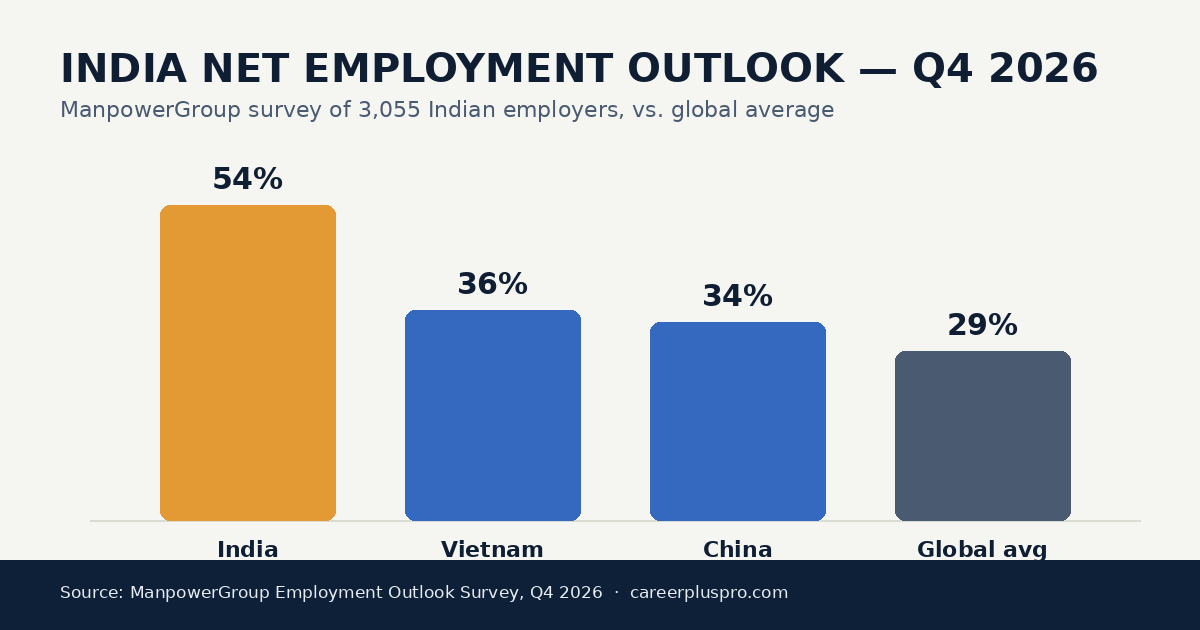
ManpowerGroup's Employment Outlook Survey for Q4 2026 (October–December), based on responses from 3,055 employers across India, put the country's Net Employment Outlook at 54% — the highest of the 42 countries surveyed, and nearly double the global average of 29%. For comparison, Vietnam came in at 36% and China at 34%.
The breakdown behind that headline number:
- 65% of Indian employers plan to increase headcount this quarter
- 24% expect staffing to stay flat
- Only 11% expect to reduce headcount
That's a 6-point jump from the previous quarter and 11 points higher than this time last year — a real, measured improvement, not just a one-off good quarter.
Where the hiring is actually happening
Every one of the nine sectors ManpowerGroup tracks reported a positive outlook, but three stood out:
| Sector | Net Employment Outlook | Notable |
|---|---|---|
| Finance & Insurance | 60% | Highest of any sector |
| Hospitality | 58% | Biggest swing — up 21 points on the quarter |
| Information/Tech | 57% | Strong despite high-profile layoffs elsewhere in tech |
That last row is the one worth sitting with, because it's where the "despite the layoffs" part of this story actually makes sense.
So why is Oracle still cutting jobs?
The layoffs and the hiring boom aren't contradicting each other — they're describing two different things happening inside the same sector at the same time.
Oracle's own cuts landed hardest on product engineering, while support and consulting teams saw far fewer reductions. That's not a company shrinking; it's a company reallocating. And that pattern shows up across the wider survey too: 69% of employers who are hiring said "changing roles and skills requirements" was their main reason — not growth for growth's sake, but a deliberate swap of one kind of role for another.
The same shift shows up in how fast companies are moving. 57% of Indian employers said their hiring process is faster than it was a year ago, largely because AI tools are now screening and shortlisting candidates automatically. If you've applied somewhere recently and felt like you were being filtered by a machine before a human ever saw your resume — you probably were.
We wrote about this underlying split in more detail a few weeks ago in India's Job Market Isn't Crashing, It's Splitting in Two, and this quarter's numbers back that read up almost exactly: it's not one job market moving in one direction, it's specific roles and skill sets moving in opposite directions at the same time.
What this actually means for your job search
Three practical takeaways if you're job hunting right now:
- Don't read layoff headlines as "no one is hiring." Finance, insurance, hospitality, and large parts of tech itself are actively adding headcount this quarter — the contraction is concentrated in specific roles, not entire industries.
- Lead with skills, not just job titles. With 69% of employers hiring specifically for "changing roles and skills requirements," a resume that just restates your old job title is competing against candidates who are explicitly positioning themselves for where the role is headed, not where it's been.
- Assume a machine reads your resume first. With more than half of employers now hiring faster thanks to AI-driven screening, a resume that isn't formatted to parse cleanly through an ATS can get filtered out before a recruiter ever sees it — run it through our ATS Checker before you send it anywhere.
If your resume still reads like it was written for the job market of two years ago, this is a reasonable week to fix that. Our free resume builder is built around exactly this — clean ATS-safe formatting, with prompts that push you to describe skills and impact rather than just list past titles.
Want your resume ready for a faster, more skills-driven hiring process?
Build my resume