Blog / Career Change
10 Fastest-Growing AI Jobs in India in 2026
Every list like this one has the same problem, and most of them hide it. There is no published dataset that ranks ten AI job titles in India by growth rate. LinkedIn's Jobs on the Rise 2026 list for India contains exactly three AI titles in its entire top 25. So anyone handing you a confident numbered list of ten roles with tidy growth percentages next to each is either making the percentages up or quietly borrowing American data.
We built this differently. The ranking below uses the strongest India-specific, role-level dataset that actually exists — Quess Corp's India AI Workforce Analysis 2026, built from roughly 3.5 lakh AI-related job postings over 90 days and published in June 2026 — and ranks by talent gap: the distance between what employers are demanding and what the available workforce can supply. Where a role sits outside that dataset, we say so and name what evidence we do have. Every number here carries its source and, where the source disclosed it, its sample size.
That makes for a less exciting list than "prompt engineering is up 200%." It also makes for a list you can actually plan a career around.
First, the number you should stop repeating
You will see "India will need 1 million AI professionals by 2026" in roughly half the articles on this topic. We went looking for the primary source and could not find one. The figure circulates without traceable methodology and sits awkwardly against a better-sourced NASSCOM projection of around 1.25 million AI professionals needed by 2027. A related claim — that 51% of Indian AI and ML roles go unfilled — traces back to a 2022 baseline, and the report it is usually credited to states no gap percentage at all.
We are naming these because a list that only shows flattering numbers is marketing, not research. Here is what held up.
The market context, briefly
India posted 290,256 AI-linked roles in 2025, and foundit's Insights Tracker projects that reaching roughly 3.8 lakh in 2026 — a 32% year-on-year rise. On Naukri's JobSpeak index, AI and machine learning hiring grew 25% year-on-year in June 2026, while IT and software services hiring fell 3% in the same month.
Read those two facts together, because separately they mislead. This is not a general tech hiring boom. It is a narrow, fast-growing band of AI-specific demand sitting inside a sector that is flat or shrinking elsewhere.
One more piece of context reframes the whole list. Quess found India has about 9.2 lakh AI professionals in total — but only 2.57 lakh of them sit in dedicated, core AI roles. The other 6.63 lakh added AI skills on top of an existing job in some other function. Companies are hiring AI-fluent accountants, marketers and analysts nearly as often as they hire AI specialists. If you already have a domain, that is the cheapest door into this market.
Tier one: roles where demand most outstrips supply
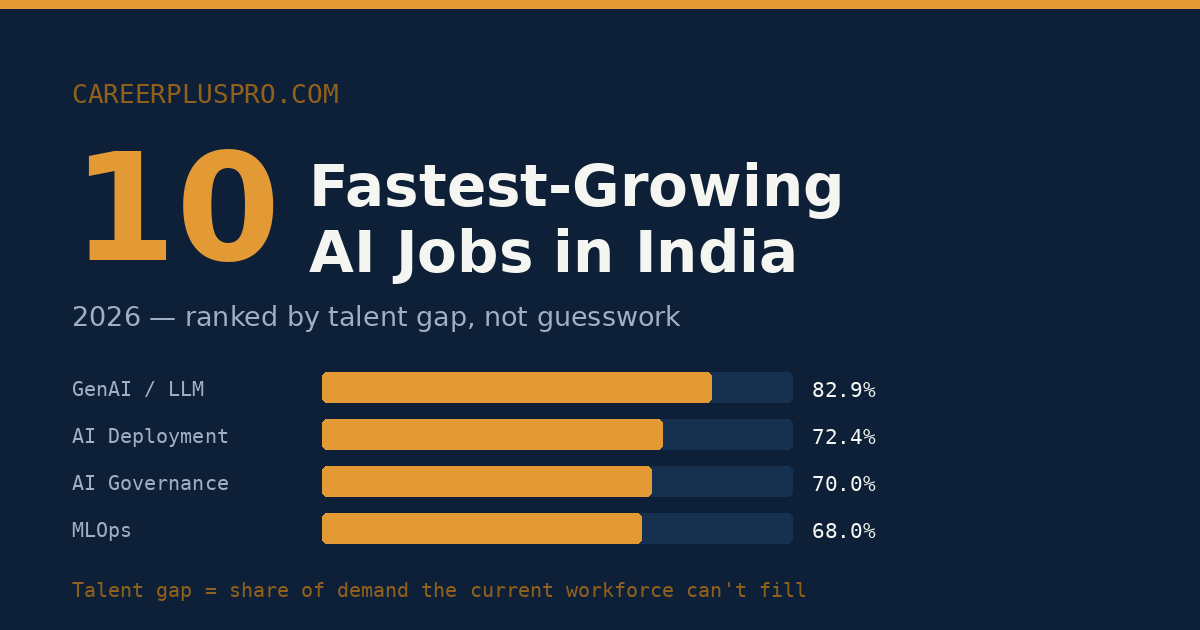
These six come directly from the Quess gap analysis. The percentage is the share of demand the current talent pool cannot meet — higher means scarcer, which means more leverage for you.
1. Generative AI / LLM Engineer — 82.9% talent gap
The widest gap in the entire dataset, and it is not close. These are the people who build production systems on top of large language models: retrieval pipelines, fine-tuning, evaluation, cost control. The gap is this wide because the skill is barely three years old and cannot be faked in an interview. IT services alone account for about 45% of GenAI demand.
What employers actually ask for: RAG, vector databases, LangChain, prompt evaluation, and at least one deployment you can describe end to end.
2. AI Deployment Engineer — 72.4% gap
Quess's own framing is that India "is not about AI builders, it is more about production." This role is the clearest expression of that. Getting a model working in a notebook is a student project. Getting it serving live traffic, within budget, without breaking when the input changes, is the job nobody can hire for.
3. AI Governance Specialist — 70% gap
The least technical role in the top tier and the most overlooked. As AI moves into lending decisions, hiring, insurance and healthcare, someone has to own bias auditing, model documentation, regulatory alignment and incident response. If you have a compliance, risk, audit or legal background, this is the shortest credible path into AI work — and you are competing against a far smaller pool than the engineering roles.
4. MLOps Engineer — 68% gap
CI/CD for models: pipelines, monitoring, versioning, retraining, rollback. The natural jump for DevOps, SRE and cloud engineers, and the transition most likely to succeed because 70% of the skillset already transfers. Bengaluru and Hyderabad hold most of the existing pool, and demand from GCCs keeps the senior end tight.
5. AI Security Engineer — 67% gap
Prompt injection, model extraction, data poisoning, adversarial inputs. A genuinely new specialisation rather than a rebranded one, which is exactly why supply hasn't caught up. Strong entry point for existing cybersecurity professionals.
6. NLP Engineer — 63% gap
The most established role in this tier, and the narrowest gap because India has been training NLP people for a decade. Still scarce, and India-specific demand carries a twist worth knowing: multilingual and Indic-language work is a real differentiator here in a way it simply isn't in Western markets.
Tier two: roles the growth rankings confirm
These two don't appear in the Quess gap table but are the only AI titles ranked by growth in LinkedIn's India list, which measures job title growth across member profiles from January 2023 to July 2025.
7. Prompt Engineer — LinkedIn's #1 fastest-growing title in India
A straight entry at number one, and the most honest thing anyone can tell you about it is that nobody can price it yet. The only India-specific salary figure we could locate came from a sample of 11 people — far too small to publish. Treat the demand signal as real and any salary number you see for this role as unverified.
Worth adding a caution: the title is consolidating fast. Much of what was called prompt engineering in 2024 is now folded into GenAI engineering roles. Build the underlying skills, not the job title.
8. AI Engineer — LinkedIn's #2, up from #12 a year earlier
The biggest single-year jump on the list. NASSCOM-BCG data puts AI engineer role growth at 67% year-on-year. The composition has shifted, though — a majority of newer postings specifically ask for RAG and vector database experience, which tells you the market moved from experimenting to shipping.
Tier three: the volume roles
9. Data Scientist and Data / Analytics roles
When Indeed's analysts broke down which job categories actually mention AI in their postings, data and analytics topped the list at 38.6%, ahead of software development at 22.8%. This is the largest single AI-adjacent function in India by volume. Growth is slower than the tier-one roles, but the absolute number of openings is far higher — which matters more if you are switching careers than a headline growth rate does.
10. AI-embedded roles in your existing function
Not a job title, and that is the point. Those 6.63 lakh professionals who added AI skills to an existing role are the largest group in the entire dataset. AI product managers, AI-fluent business analysts, marketers who can build automation, finance professionals running AI-assisted forecasting. Quess found nearly 68% of AI hiring demand now points at core AI roles, but the available workforce sits mostly in these embedded positions — which is precisely why they are realistic to enter.
Where these jobs actually are
Geography concentrates hard, and the concentration is worse than most articles admit. Based on more than 64,500 AI-tagged Naukri listings analysed by CBRE as of December 2025: Bengaluru holds 25.4% of India's active AI postings, Delhi NCR 24.8%, and Mumbai 19.2%. That is roughly 70% of the national total in three metros. Hyderabad follows at 12.5%, Pune at 9.6%, Chennai at 6.4% and Kolkata at 2.1%.
Tier-2 cities do appear in foundit's data as emerging hubs — Jaipur, Indore and Mysuru are named — but "emerging" is the correct word. If you are optimising purely for AI job density right now, the three metros are where the roles are.
The experience band nobody mentions
Here is the most actionable number in the Quess report, and we have not seen it quoted anywhere else. The steepest demand sits in the three-to-five-year experience band, at 49.5% of demand. In that band there is active demand for about 172,000 people against an available pool of roughly 247,000 — but only a smaller production-ready segment of that pool actually holds deployment-scale skills.
Read that carefully, because it cuts both ways. If you have three to five years of experience in anything technical and can add production AI skills, you are aiming at the widest part of the demand curve. If you are a fresher, you are not — entry-level is the most crowded end, and foundit's data confirms hiring growth is strongest at mid and senior-mid levels, not entry.
About the salary numbers you'll see elsewhere
We are deliberately not giving you a single figure per role, and the reason is worth understanding.
Two legitimate measurements exist and they are not interchangeable. PayScale reports average total compensation, self-reported by employees. Indeed reports average base salary, derived from job postings. For a Data Scientist, PayScale's all-experience figure is ₹10.18 lakh; Indeed's is ₹11.98 lakh, from a sample of 502. Neither is wrong. They measure different things, and blending them produces a number that describes nobody.
The spread within a role is also larger than the spread between roles. A fresher at an IT services firm and a senior GenAI engineer at a product company both get averaged into "the average AI engineer salary," which is why that figure is close to useless for planning. Most of the salary content in this niche is published by companies selling AI courses, and their ranges vary by a factor of ten for identical job titles. Check the sample size and who is publishing before you trust any of it.
What to actually do with this
The pattern across every source we checked is the same: demand has moved from building models to deploying, governing and securing them. The gaps are widest at the production end and narrowest at the "I did a course" end.
So the practical read is unglamorous. Fundamentals that appear consistently across every dataset — Python, SQL, statistics — before whichever framework is trending this month. One deployed project you can talk through in detail beats three certificates. And if you already have a domain in finance, healthcare, compliance or security, the fastest route in is almost certainly AI governance or AI security in your sector, not competing head-on with CS graduates for engineering roles.
One last thing about the hiring process itself. LinkedIn's January 2026 research found 84% of Indian professionals feel unprepared to job-hunt this year, and applications per opening in India have more than doubled since early 2022. Nearly 74% of Indian recruiters say it has become harder to find qualified candidates. Both those things are true at once, which means the bottleneck is not usually the number of jobs — it is whether your application makes the skill legible in the six seconds it gets.
That is a fixable problem, and it is a different problem from learning AI.
Sources
Quess Corp, India AI Workforce Analysis 2026 (June 2026, ~350,000 job postings over 90 days) · foundit Insights Tracker (January 2026, 290,256 AI roles posted in 2025) · Naukri JobSpeak (July 2026) · LinkedIn Jobs on the Rise India 2026 and LinkedIn India research (January 2026) · CBRE analysis of 64,500+ AI-tagged Naukri listings (December 2025) · Indeed Hiring Lab occupation breakdown · NASSCOM and NASSCOM-BCG · PayScale and Indeed salary data as cited. Figures reflect the most recent published data as of September 2026.
Want help putting this into practice?
Build my resume